Floating floor against impact noise: wool under the screed
Footsteps and chairs upstairs are heard through the floor slab, and no ceiling plaster cures it. What cures it is a floating screed on a resilient layer that touches neither the slab nor the walls. Here is which wool to lay and what goes around the edges.
What a floating floor is
Impact noise travels through the structure, so the screed is separated from the slab by a resilient layer and from the walls by an edge strip. If the screed rigidly touches a wall, a pipe or a box anywhere at all, the effect is lost. The benchmark for a floor between flats is a weighted impact sound level of no more than 60 dB; Georgia has no noise standard, so we rely on the Russian SP 51. Airborne noise — voices, a TV — is a different task that a floating floor barely addresses.
Which wool: 110 kg/m³
Our main choice is the 110 kg/m³ slab: 30 mm — 10.25 ₾/m² (pack of 5.76 m²), 50 mm — 15.95 ₾/m² (pack of 4.32 m²). The 120 kg/m³ slab also works but costs more; 140 kg/m³ (25.79 ₾/m² for 50 mm) goes under underfloor heating and heavy loads. Slabs of 70 and 100 kg/m³ do not go under a screed: the 70 will be crushed, and the 100 has no confirmed compressive strength. The option that is right on paper is a dedicated floor slab with a declared compressive strength of at least 30 kPa and a declared dynamic stiffness: those come from system suppliers, and the manufacturer gives a noise-reduction figure for them. We lay our 110 — it works, but there is no test report for it, so we do not promise decibels.
Why not XPS or EPS
Impact sound insulation depends on the dynamic stiffness of the layer: for stone wool of 100–140 kg/m³ it is 14–19 MN/m³, for 50 mm EPS — 78, for 5 mm foamed polyethylene — 115. The stiffer, the worse. XPS is a good insulation under a screed over a cold basement, but against the neighbours' noise it hardly helps.
Thickness
30 mm is enough for sound; 50 mm gives a small gain and a margin for an uneven slab. Thicker is not needed for sound — the gain is small and the floor rises. If there is a cold basement or a passage below, the thickness is then calculated for heat.
Build-up from the bottom
- Floor slab: joints and voids filled; with large unevenness — a levelling screed.
- Wool in one layer, tight, staggered joints, no gaps.
- 0.2 mm PE film with a 10–20 cm overlap, seams taped, turned up the wall above screed level.
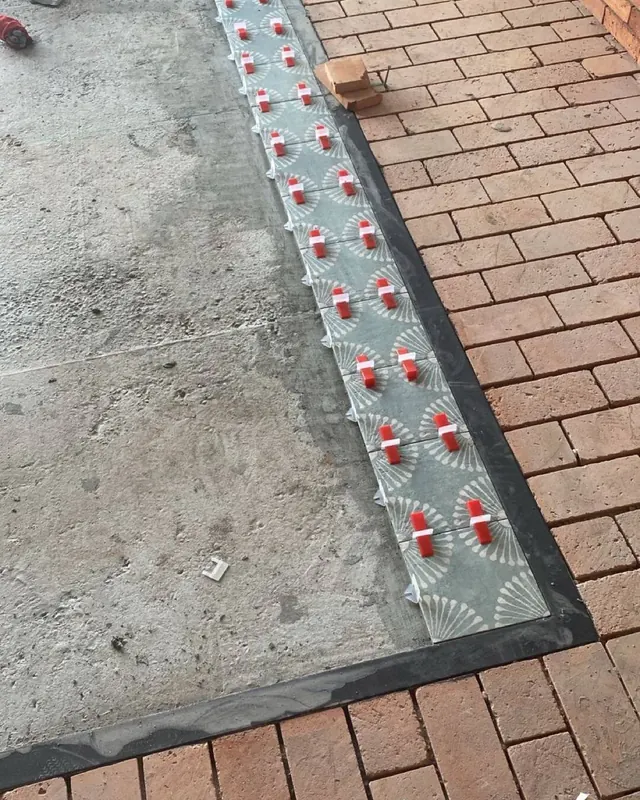
- Edge strip around the perimeter for the full screed height: an 8–10 mm damping tape (available in any shop) or a 10 cm strip of the same wool — that is how we do it.
- 100×100 mm Ø4 mesh on wide-base spacers, 4 per m² (0.24 ₾, box of 250): a narrow spacer punches into the wool.
- Screed at least 50 mm, concrete B15 or mortar from M200; on a resilient layer a minimum of 40 mm.
- Pipes and boxes pass through the screed in sleeves with a 25–30 mm gap; skirting is fixed to the wall, not the screed; the edge strip is trimmed after the floor finish is laid.
Example for 60 m²
A flat with 50 m of wall perimeter, 30 mm wool, 50 mm wet screed: 110 kg/m³ slab under the screed — 63 m², 11 packs — 649.4 ₾; the same slab for the edge strip — 5 m², one pack — 59 ₾; spacers — 240 pcs, one box — 60 ₾. 768.5 ₾ from stock in total, about 13 ₾ per m². Separately: about 76 m² of film, about 66 m² of mesh, about 3 m³ of mortar.
Mistakes
- The screed touches a wall, a pipe or a door frame — sound bypasses the resilient layer.
- A 50 mm screed without mesh on wool cracks over the slab joints.
- XPS or EPS “against noise” — a stiff layer gives almost nothing.
- 70 kg/m³ wool under a screed — crushed next to the wardrobe and along the walls.
- A fireplace, safe or machine heavier than 2 t — a screed on a resilient layer is calculated separately.
- Expecting a decibel figure from a home-made build-up: only tested factory systems give one.